Can Money Save Nature? From a New Currency to a Citizen’s Dividend
Can Money Save Nature? From a New Currency to a Citizen’s Dividend
In November 2014, we asked a bold question: can a new currency save the planet?
We had just launched DIO, a digital complementary currency designed to “return value to Nature”. Business leaders, conservationists, economists and currency designers met at the Château de Bonmont near Geneva to discuss it. The original article is still online, unchanged, as part of our history.
Twelve years later, the question has not gone away. If anything, it has become more urgent. But our answer has changed: not in its direction, but in its shape.
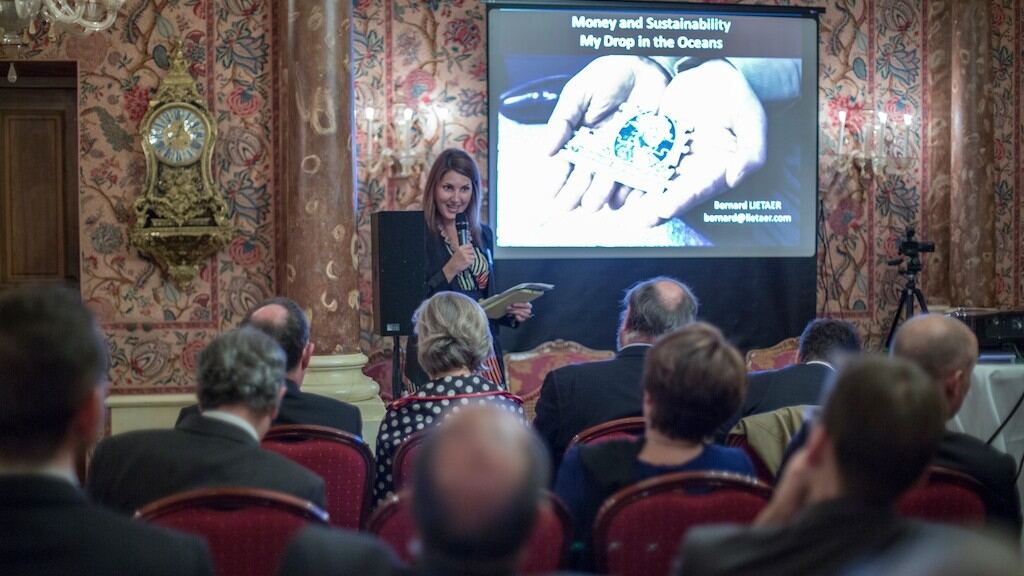
What we proposed in 2014
The idea was simple to state. DIO would be issued equally to individuals as credits, “reflecting Nature’s shared value to all of us”. Those credits became spendable rewards through sustainable actions recorded on an online platform, and could then pay for part of a purchase at participating businesses.
Three convictions sat underneath it:
- Nature’s costs are hidden. Because they are not priced, they are not accounted for by governments, businesses or consumers.
- Incentives work better than pressure. People and businesses should be rewarded for sustainable choices, not only asked to make sacrifices.
- Nature is shared wealth. Its value belongs to everyone, so the reward for protecting it should start from an equal share.
What the room told us
Re-reading the speakers’ words today, what stands out is how little of the diagnosis has aged.
Bernard Lietaer summed up the measurement problem: “what you can’t measure you can’t improve.” Judy Slatyer, then COO of WWF International, pointed at the behaviour gap: people “want to do something but they don’t know how … and they don’t get rewarded for it.” Peter White of the WBCSD noted that we had been “talking about the need to internalize externalities for probably 40 years”, and that pushing people does not work, “so having incentives is key.”
Pavan Sukhdev, who led TEEB, added the point that matters most for us today. Nature is a public wealth that billions of people depend on directly. So the challenge is to find “forms of public management of public wealth that ensure equity.”
That last remark carried more weight than we fully recognised at the time.
What still holds
The core diagnosis has stood up well. The economy still tends to work in a fixed order: make money first, then (maybe) think of Nature. The costs of acting responsibly are immediate and land on whoever acts. The benefits are delayed, collective and spread thin. Under those conditions, good intentions do not scale.
The language of “Natural Capital” has moved from the margins into mainstream policy and business reporting. That is real progress. But measuring and disclosing nature-related impacts is not the same as changing the signals that shape everyday decisions. A household choosing what to buy, or a small business choosing a supplier, still mostly sees prices that leave Nature out.
What changed in our thinking
The biggest change is that we no longer frame the answer mainly as a new currency. We frame it as a value signal that has to work inside the economy people already use.
| 2014: a new currency | Today: a Citizen’s Dividend for Nature |
|---|---|
| A separate digital currency, accepted by participating businesses. | Recognition of Nature’s value embedded in everyday transactions, in the money people already use. |
| Credits issued equally to individuals. | A dividend expressing a shared entitlement to Nature’s wealth, together with a shared obligation to sustain it. |
| Rewards for sustainable actions. | Value signals that make sustainable choices economically meaningful, not just morally preferable. |
| Legitimacy through adoption by users and businesses. | Legitimacy through democratic process, with scientific institutions validating how ecological value is measured. |
| One social enterprise did both the thinking and the implementing. | The thinking (mydropintheoceans.org) is kept separate from a commercial implementation (mydio.com). |
Each of these shifts answers a lesson from the 2014 conversation.
Equity needs public legitimacy. Sukhdev’s point about the public management of public wealth cannot be met by a private platform alone. A mechanism that claims to represent everyone’s share of Nature needs the consent of everyone. That is why our Theory of Change places long-term legitimacy with citizens and democratic process. It is also why we take public scepticism seriously, as we explored in Why the Swiss Said No to Free Money.
Measurement has to be able to improve. Lietaer was right that what cannot be measured cannot be improved. But no single method of valuing Nature is final. We now treat TEEB, environmental profit-and-loss accounting (the approach Kering’s Michael Beutler described at the event), biodiversity metrics and future methods as evolving inputs, not fixed truths. A good mechanism should create demand for better measurement over time, rather than lock in the best guess of its launch year.
The signal has to meet people where they already spend. In 2014, DIO asked people to adopt a new means of payment. Today we think the signal is more powerful when it sits inside ordinary transactions. One way to picture the longer-term direction is a kind of dynamic VAT. In a conventional tax, consumers work harder to pay the value added. Under a Citizen’s Dividend for Nature, the value attributed to Nature would increasingly be met by a dividend earned through better collective stewardship.
Thinking and implementing are different jobs. A think tank needs to be free to question its own ideas. An implementation needs to deliver in real market conditions. Keeping them apart helps each stay honest.
So, can money save Nature?
Not on its own, and not by moral appeal. But money is how an economy says what it values. As long as its signals leave Nature out, we ask people and businesses to protect Nature against their own interest. That asks too much of too many people, every day.
The question we asked in 2014 was whether a new currency could save the planet. The question we ask now is narrower and, we think, more useful: how do we make Nature’s value visible in the money we already use, fairly, and with public consent?
Further reading
- Can a New Currency Save the Planet? The original 2014 article
- Theory of Change: how the Citizen’s Dividend for Nature fits together
- Make Money First, Then (Maybe) Think of Nature
- From Central Bank Mandates to Everyday Transactions
- What if Stewardship Was Financially Recognised?